An Ink Cleaner that Works!

Ink Cleaner That WORKS!

Ink and coating cleaners have taken various forms over the years. Our technical team agrees that a blend of Ethyl Acetate and Isopropyl Alcohol was once a very effect cleaner.  Although it cleaned well, it had a flashpoint below 100° Fahrenheit and a strong, pungent odor – especially in smaller pressrooms.
At Magnum Inks & Coatings we handle a lot of ink. The ink and coating manufacturing process requires a clean working environment that we can consistently rely on to create our best-selling inks and coatings.  As you can imagine, we are constantly cleaning mixing equipment, aniloxes, floors, lab benches, ink knives, etc.  Our ink and coating cleaner must be safe to use, low odor, and most of all – effective.

Magnum Ink Cleaner is the “go to” cleaning solution for our plant which makes it a logical solution for our ink and coating customers as well.  Our multi-purpose cleaner is environmentally friendly and is great for cleaning water-based and UV inks and coatings. Magnum Ink cleaner is powerful and easy to use. It cleans quickly and safely thereby minimizing press downtime and helping your operator setup the next job quickly.  Magnum Ink Cleaner is low VOC and non-Hazardous and ideal for packaging facilities in need of a green solution.  In addition to it’s “GREEN” characteristics, it is non-flammable and has a very low order.   Often this is in stark contrast to other, more volatile, cleaners that can be found in the market that are less safe to use.

Magnum Ink Cleaner is a concentrate.  You can use it get those hard-to-clean areas in your pressroom or simply dilute with water for general purpose cleaning. Press operators will love this cleaner due to its effectiveness, mild odor, and versatility.  Visit the Magnum Ink Cleaner product page on the Magnum Inks & Coatings website for more information!

An Ink Cleaner that Works!2018-06-18T19:23:26+00:00

How You Benefit From Magnum’s Commitment To Improvement

How can you benefit from continuous improvement?

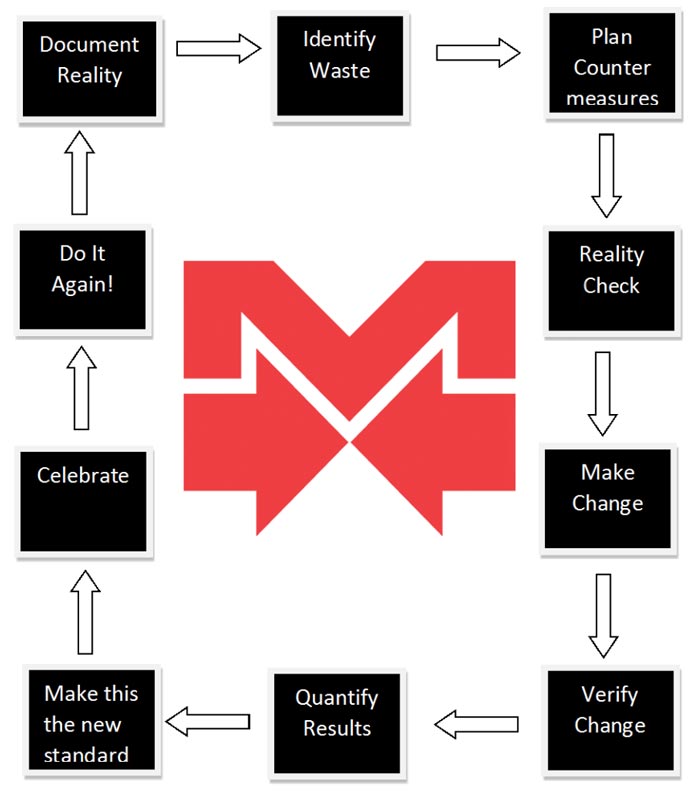
Kaizen, also known as continuous improvement, is a long-term approach to work that systematically seeks to achieve small, incremental changes in processes in order to improve efficiency and quality. It originated in Japan and the word translates to mean change (kai) for the good (zen). Kaizen events make immediate improvements and are useful throughout the enterprise. Some industries benefit a great deal from the Kaizen activities as opportunities are discovered on a daily and weekly basis. In a sense, it helps bring people together to create a powerful engine of improvement.

magnum improvement process

What is the Kaizen process?

The event normally spans a 3 – 5 day period and involves a total commitment from team members. It aims to decrease waste through eliminating overproduction, improve quality, be more efficient, have less idle time, and reduce unnecessary movement. Kaizen is best for Lean organizations, small teams, and organizations that give employees some degree of autonomy and responsibility.

How does Magnum’s philosophy of process improvement benefit our customers?

Kaizen can be a powerful team building approach that brings people from all levels together. Participation can serve to improve moral and job satisfaction as much as it improves production, and costs. When you bring this system into your workplace you will be surprised at how much small changes can make, and how the culture of continuous improvement can help your organization thrive. Magnum’s utilization of this continuous improvement process translates to money savings and turn potential losses into profits. It also means at Magnum we can in turn pass those savings and profits on to you the customer.

At Magnum our customers come first which leads to the processes and systems that streamline the whole customer experience. We constantly look for ways to continually improve this experience. Our frictionless goal is reached by our people, systems implemented, innovative technology and our culture of continuous improvement.

Contact Us Today!

Learn more about what Magnum is committed to improving.

Contact us today!
Contact Us Today!
How You Benefit From Magnum’s Commitment To Improvement2018-07-19T19:01:09+00:00

Customers Love Soft Touch

Customers Love Soft Touch

Soft Touch coatings have become a very popular coating option for commercial printers and narrow web label converters because the product captures the customer’s attention through engagement with the printed piece. A Soft Touch coating is one of many coating offerings that is applied over the top of a printed image with the intent of getting the customer to interact with the product by touching it to enjoy the soft, velvet-like feel. Luxury and sophistication are the terms people typically associate with products that feature this kind of coating. This is all in an effort for the customer to increase engagement with a printed piece by stimulating the sense of touch.

Research has shown that if you can get a shopper to pick-up and interact with the product they are significantly more likely to put the product in their shopping cart. Some particularly well-done examples of Soft-Touch application are found in the personal care aisle of retail stores. Lotions, creams, and other products meant to communicate a soft-feel use this technology to extend that impression to the customer. There are also some really eye-catching examples with catalogs, direct-mail pieces, and even business cards. When the customer extends their interaction with the printed information by engaging more than one of their senses, that information or feeling is more likely to remain with them.

Soft Touch coatings are easy-to-run. They must be mixed well prior to use to make sure the soft touch ingredients are suspended in a homogeneous solution. It is imperative that you employ the highest quality Soft Touch coatings like those provided by Magnum Inks and Coatings. Magnum’s water-based Fuzzy Touch and UV Super Soft Touch coatings have been designed to provide a concentrated Soft Touch coating that can be successfully applied in just one pass. To improve rub-resistance of Fuzzy Touch talk to Magnum about using our X-Linker for water-based inks. A small amount can go a long way to protect the amazing finish that is created.

Click the link below to get in touch with our technical sales team to discuss your specialty coating needs!

Customers Love Soft Touch2018-08-06T20:34:56+00:00

Centerline GCMI Ink System

A Centerline GCMI Ink System… an idea that is a long time in coming.

MIC-GCMI -- TWO-BOXES-WITH-TAGWhat exactly are GCMI colors?  I am sure you have heard these terms through the years in the Corrugated press room and never fully understood the roots of the acronym.   These colors were once offered by the Glass Container Manufacturers Institute and were adopted by the corrugated industry long ago.  GCMI colors offer a standardized color palette that is consistent and easy to duplicate for different print jobs.
As they are pre-mixed standard colors, these GCMI colors have become a cost-effective option for corrugated printers.  The GCMI colors also have equivalent, but limited, matches on the Pantone and PMS palettes.  If you have a color match with a GCMI color specified, the printer can confidently select the specific GCMI ink and know exactly how it is going to look on the box.  This relationship allows the printer to offer cost effective options to their customers.

One of the drawbacks to this ink and color system is color-matching.  Specifically, matching the proper color to the printed stock.  Have you ever had a customer reject a job because the ink did not match the GCMI color specified?  It is common to discover that the the operator or ink technician chose the wrong ink for the substrate.

This is a common issue as the GCMI book specifies colors on both Natural Kraft and Mottled White stocks. Some Ink companies work hard to make sure the inks match the sample in the book as closely as possible. The problem occurs when the operator accidentally chooses the correct color for the job – but for the wrong stock.

Magnum Inks and Coatings has a solution for this issue. We have created a “centerline” GCMI ink system. This means that our inks will match the sample in the GCMI book – regardless of whether you run on Natural Kraft or Mottled White stock.  This formulation gives you the ability to use one ink series for both substrate types.  As we already know, the press operator has a hard enough job as it is.  One ink series eliminates the confusion of pairing an ink type to a substrate and reduces your overall inventory of stocked inks.

Magnum Inks & Coatings are strong, possess high-hiding capabilities and are easy-to-run.  The “centerline” ink system allows you to service your customers better, reduce ink matching issues and simplify your ink inventory management.  Contact Magnum Ink & Coatings to sample some of your most commonly used GCMI colors.

Centerline GCMI Ink System2018-07-12T14:51:16+00:00

Tired of UV Matte Coatings that thicken when you run them?

Tired of UV Matte Coatings that thicken when you run them?

Magnum Inks and Coatings - UV Matte CoatingRunability is one of the most important characteristics of an ink, coating or varnish.  Particularly if you finally got the customer to commit to that long run you have been asking for!  The last thing you and your operators want to do is stop the press because the coating or varnish isn’t running properly.  It is imperative that the press run at top speed and without interruptions.

At Magnum Ink & Coatings, we have recently discovered a Matte coating runability issue.  Have you ever noticed that as you run your UV Matte coating on longer runs the coating tends to build up and thicken in your chamber or coating pan?

The cause of this is generally found in one of the components of the matte coating itself – the matting agent. Matting agents are often made from fumed silica. The silica is suspended in a coating and the particles deflect light giving off a matte appearance instead of gloss. The challenge comes when after running for some time your matte coating begins to thicken.

The cause of the thickening is that the doctor blade is shearing or separating the matting agent from the coating vehicle. You may not notice it but the coating you are laying down is also not as dull as it was intended to be because less matting agent is getting applied to the substrate. The matting agent is simply collecting in the coating chamber or pan. The remainder is a thick gelatinous-like sludge that becomes unusable.

Magnum Inks & Coatings’ specially formulated UV Matte coating eliminates this phenomenon.   No longer will you have to stress over low press speeds and press downtime due to adjusting the coating unit.  For more information please visit the Magnum Inks & Coatings’ product page and contact a member of the team for a sample!

Tired of UV Matte Coatings that thicken when you run them?2018-07-12T14:51:07+00:00

How to Coat “Difficult” Digital Inks

Many commercial printers have purchased a digital press and a UV offline coating unit in order to provide their customers with printed pieces with an aesthetically pleasing coating. However, printers are often surprised at the difficulty they encounter when trying to lay down a smooth coating film over certain hard-to-coat digital inks. The problem may present itself as poor adhesion (easily scratching or scuffing) or as reticulation (where the ink actually beads-up and doesn’t lay smoothly over the surface of the ink). These problems are especially evident in heavy black or dark solid colors.

The problem

Many digital presses use ink that contains oil or other additives that can migrate to the surface—even after the ink feels dry—and prevent the coating from adhering properly.

The solution

Fortunately, all is not lost. Here are three tips to help you coat over these sometimes difficult digital inks.

Tip #1: IR drying

Although the infrared drying feature on coating equipment has many uses, mostly related to drying aqueous or solvent-based inks and coatings, many operators don’t think about IR when working with UV digital ink—which cures under UV light and not by infrared or heat drying. In the case of these inks where oils or additives have migrated to the surface, a quick pass under the IR dryers can flash off some of the offending material and allow more of the coating to adhere.

Tip #2: Coat it quickly

Consider applying the coating as soon as possible after completing the print run. The longer the printed pieces sit, the more time the materials in the ink have to migrate to the surface and make coating difficult. Coating and curing over these inks immediately after they come off your press denies the materials in the ink the chance to migrate to the surface where they cause coating problems.

Tip #3 Use a coating designed to be run over Hard-to-Coat Digital Inks

Specialized coatings have been designed to coat over these  hard-to-coat digital inks. Magnum Inks & Coatings®, offers its LithoCoat™ Digital UV line of coatings specifically to overcome this challenge. These coatings give you the ability to lay down a smooth, even film providing that amazing printed piece your customer is looking for.

How to Coat “Difficult” Digital Inks2018-06-08T16:16:37+00:00
Go to Top